
More Organizations Are Turning to Interim Leadership for Stability and Impact
The recent slowdown in my blog posts is not an excuse—it’s a manifestation of the very dynamics this blog exists to explore: the structural, cultural, strategic, and operational challenges facing nonprofits and other social-impact enterprises. In December alone we have started new interim leadership engagements in RI, NY, DC, FL and TX, and January is likely to be equally busy..
These issues are not solely the product of today’s economic or political climate (although those certainly add pressure). They reflect longstanding vulnerabilities that become visible during moments of leadership transition, financial strain, or strategic drift.
Below are several of the challenges we are hearing most frequently—across organizations of all sizes, missions, and budgets—paired with the approaches that seasoned interim leaders use to stabilize organizations and position them for long-term success.
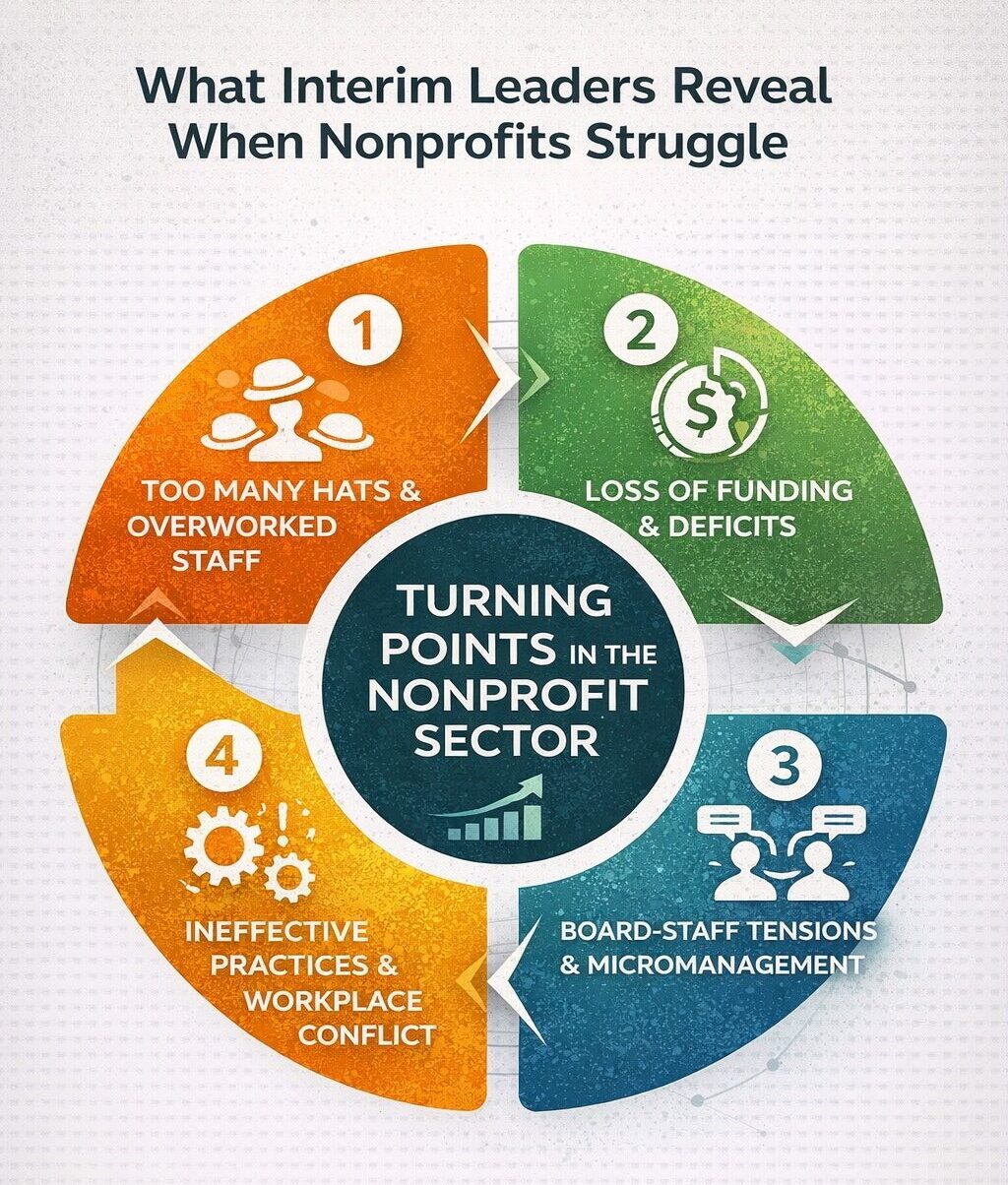
1. People Are Wearing Too Many Hats
Challenge
As hiring slows or freezes, work gets redistributed—often without regard for training, capacity, or clarity. Staff stretch themselves across multiple roles, burnout increases, and turnover accelerates. Even as unemployment rises, nonprofits struggle to retain talent.
Interim Leader Opportunity
Professional interim leaders begin by assessing what staff are capable of doing—and what they are willing to learn. They realign responsibilities, connect workflows, and clarify expectations so the right people are in the right roles, set up for success rather than exhaustion.
2. Loss of Key Funders and Persistent Deficits
Challenge
When turnover hits, funder relationships often erode. At the same time, revenue declines or grows more slowly while staffing costs continue to rise. Some organizations attempt to replace lost funding with new programming, inadvertently expanding commitments instead of stabilizing them.
Interim Leader Opportunity
Interim executives analyze program-level income and costs to clarify what is truly sustainable. They re-engage funders, rebuild trust, and help boards make decisions grounded in financial reality—whether that means right-sizing, restructuring, or investing in areas with real potential.
3. Board–Staff Tension, Misconceptions, and Micromanagement
Challenge
Boards can drift into one of two unhealthy extremes: becoming too hands-off and failing to ask critical questions, or becoming too hands-on and directly managing staff. Meanwhile, executive leaders sometimes avoid sharing bad news, creating blind spots and eroding trust.
Interim Leader Opportunity
A skilled interim leader reestablishes transparency, strengthens communication, and resets expectations. They help boards understand where the organization stands and what support the staff actually needs. They rebuild trust and transparency with the goal of establishing a healthy long-term partnership.
4. Silos, Conflict, and Toxic Behaviors Impacting Morale
Challenge
Workplace inequities e.g. who must be onsite, pay disparities, unclear advancement pathways, along with conflicting agendas or poor leadership practices, undermine morale. These dynamics can quickly erode culture and productivity.
Interim Leader Opportunity
Interim leaders prioritize connection: listening, valuing individual contributors, and bringing teams together around mission and impact. By modeling transparent, respectful leadership, they help repair culture and create environments that attract and retain mission-aligned talent.
5. Operational Inefficiencies and the Weight of “We’ve Always Done It That Way”
Challenge
Organizations led for years by founders or long-tenured executives often rely on legacy processes that were built around a particular mode of operation and may no longer match current needs. When new leaders arrive, they are surprised by outdated systems, inconsistent practices, and missed opportunities.
Interim Leader Opportunity
A professional interim executive conducts an objective sustainability assessment to uncover risks and inefficiencies and to identify what needs to change. They modernize systems and processes, introduce best practices, and create the structural foundation that enables the next permanent leader to succeed—not just survive.
The Bottom Line: Interim Leadership as a Catalyst for Impact
This blog will continue to explore how social-impact enterprises can thrive despite the forces working against them. But one truth has become increasingly clear:
A skilled interim leader, working shoulder-to-shoulder with staff and board members, is often the fastest and most effective way to stabilize an organization and restore its path to sustainability and impact.
Interim leadership isn’t a pause. It’s a pivot—a strategic intervention that gives an organization the clarity, structure, and momentum it needs to move forward confidently.
Thanks for reading! Subscribe for free to receive new posts, and please share my work.