
It has been said that “culture eats strategy for breakfast (or perhaps for lunch),” and my observation, through our work, is indeed that culture drives the ability to execute—and execution ultimately drives impact.
Culture is typically the domain of the executive leader of an organization. On the other hand, in mission driven organizations clarity as to the vision and goals is equally vital and this is the domain of the board.
For a nonprofit, more appropriately called a social impact enterprise, to be highly effective, there needs to be true partnership between board and staff leadership so that both strategy and execution are working together. Yet all too often, the very structure of social impact enterprises—and the way stakeholders understand their roles—gets in the way of success, rather than contributing to it.
The Board’s View: Trust, Oversight, and the Perils of Distance
Many board leaders view their role as strategic: providing oversight and setting direction and expecting staff leadership to manage the day-to-day and adhere to their implicit or explicit directions. Frequently, however, boards effectively cede substantial responsibility for setting direction to their staff leader hoping that their actions will be in the best interests of the organization and will be aligned to the mission.
At the other extreme, some board leaders and board members consider themselves as the people running the organization and see it as their responsibility to micromanage some aspects of the work. Neither of these extremes is healthy.
Without regular communications and transparency, either relationship can quickly turn into blind spots. When boards are too distant they often discover too late that the people, systems and assumptions they relied on were flawed:
-
- Fundraising pipelines were weaker than anticipated.
- Financial controls and reporting had gaps or was incomplete.
- Staff turnover signaled deeper issues in culture or management.
- Programs quietly drifted from the mission.
When boards are too “in the weeds” they usually hamstring staff, adding to already excessive workloads and reducing staff agency and engagement.
When either scenario persists, more systemic problems surface which can threaten the organization’s impact or reputation and further erode trust between board and staff.
One early warning sign that the relationship between board and staff leadership lacks trust is often a tightening of control by staff leadership, including constraints as to who the board can talk to, limited boardroom discussions, and infrequent reporting, communications and engagement. Another red flag is the formation of too many board committees overseeing and controlling too many aspects of the work, often with little coordination. In either scenario, the lack of communication exacerbates alienation, distrust and erodes the ability to achieve organizational goals.
The Staff’s View: Leadership Shifts and Uncertain Ground
Effective Executive Directors build their success and longevity on trust and shared understanding with the board—knowing what is expected and what support they can count on. But sometimes things change: a new chair or a new cohort of board members sometimes brings new ideas, new priorities, and even a different interpretation of the mission itself. While fresh perspectives should always be welcome, without a clear understanding of the implications for staff, clients and other stakeholders, significant changes in direction or approaches to governance can be disruptive to the mission, to service delivery and to staff morale and engagement.
I’ve spoken with many Executive Directors who were regarded as highly effective leaders—until a change in board leadership introduced a “new direction” or a “fresh assessment” of the current one. What follows is often conflict, misalignment, and turnover. Staff departures ripple through the organization, disrupting programs, fundraising, and culture. Even when new ideas are good, the organizational cost of abrupt change, without thoughtful planning, can be high in social impact enterprises.
Changes in strategy or execution can and often need to be made to ensure sustainability and delivery on the mission. So what is needed in order to establish a foundation for resilience and the ability to adapt?
Partnership
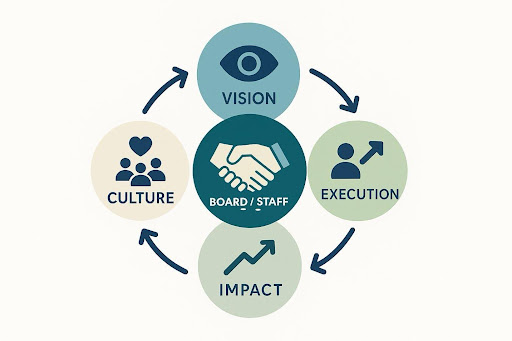
For social impact enterprises to be effective and sustainable, boards and staff must operate in true partnership—not as parallel authorities, but as complementary forces aligned around mission and impact.
That partnership looks like this:
-
- Shared Vision, Distinct Roles:
The board defines what impact looks like and ensures that it remains relevant to community need. The staff determines how to achieve it, grounded in real-world knowledge of operations, clients, and constraints. - Collaborative Financial Stewardship:
Budgets are more than numbers—they are expressions of strategy. Both board and staff must understand the tradeoffs inherent in spending, saving, and investing. Revenue generation is a shared responsibility. - Joint Risk Assessment:
When external conditions shift or crises arise, both governance and management bring critical perspectives to the table. Staff understand operational vulnerabilities; boards can bring broader networks, strategic insight, and objectivity. - Transparency and Trust:
The best organizations foster cultures where information flows freely, tough questions are welcomed, and differing perspectives are valued. Trust is not the absence of inquiry—it is the presence of openness.
- Shared Vision, Distinct Roles:
From Oversight to Partnership
When boards view themselves purely as overseers and staff view boards as distant or intrusive, alignment frays. When they engage as partners in pursuit of impact, both governance and execution are strengthened.
Social impact enterprises thrive when their culture encourages shared ownership of results—when board and staff see themselves not as separate entities but as parts of a unified system. Strategy, culture, and execution become mutually reinforcing.
In the end, impact isn’t achieved by the work of the staff or the board alone. It is the product of partnership—of an environment that aligns vision with execution, and purpose with performance.