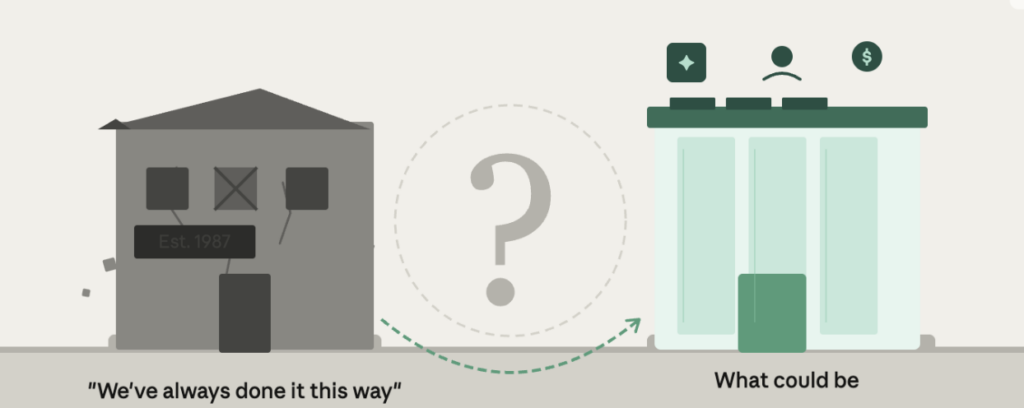
There is a phrase that surfaces in almost every nonprofit I have ever worked with. Sometimes it comes from a long-tenured staff member defending a cumbersome process. Sometimes it comes from a board member explaining why the annual gala must happen in November, at the same hotel, in the same format it has used for the past fifteen years. The phrase is this: “We’ve always done it that way.”
It is not said with malice. It is usually said with a kind of institutional loyalty, even pride. But in a landscape that is shifting faster than most nonprofits are moving, it may be the most expensive sentence in the sector.
The World Has Changed. Have You?
The communities nonprofits serve are not static. Demographics shift. Needs evolve. The family experiencing housing instability in 2025 may have very different circumstances — and very different expectations of service delivery — than the family your organization was founded to serve twenty years ago. Program models that were innovative a decade ago can become obsolete not because they failed, but because the problem changed shape.
Funders are changing too. The philanthropic landscape has undergone a meaningful transformation in recent years. Many foundations are prioritizing unrestricted general operating support over project-specific grants. Others are demanding more rigorous outcome measurement, greater equity in organizational practice, or explicit alignment with their evolving strategic priorities. Government funding streams are subject to political and budgetary pressures that can shift overnight. The nonprofit that built its revenue model around a handful of reliable sources — and has not revisited that model in years — is one grant cycle away from a crisis.
Workforce expectations have shifted as well. The staff members walking through your doors today — and equally important, the ones choosing not to — have different expectations around flexibility, compensation transparency, professional development, and organizational culture than the workforce of even five years ago. Talent management practices that once felt adequate now generate quiet frustration, quiet quitting, and loud turnover.
And then there is technology. Specifically, artificial intelligence. AI is no longer a theoretical tool on the horizon. It is available, increasingly affordable, and being adopted by peer organizations right now — for grant writing support, client intake and triage, donor communications, financial analysis, and operational efficiency. Organizations that dismiss it as a corporate solution, irrelevant to mission-driven work, risk falling behind in ways that will compound over time.
The Rise of the Specialist
One of the most significant and underutilized shifts in the nonprofit support ecosystem is the rise of outsourced service providers for core operational functions. Finance, human resources, IT management, and even executive leadership — all of these can now be accessed through experienced, mission-aligned specialists on a fractional or contract basis.
This matters enormously for small and mid-size nonprofits. The expectation that every organization must employ a full-time CFO, HR director, and IT manager — regardless of budget or scale — is a legacy assumption that costs the sector dearly. A skilled fractional CFO can provide financial leadership and oversight at a fraction of the cost of a full-time hire, often bringing broader nonprofit sector expertise than a single hire would offer. Outsourced HR providers can bring consistency, compliance, and best-practice policies that in-house generalists stretched thin simply cannot maintain.
These are not compromises. In many cases, they are upgrades. And yet, many boards and executive directors continue to staff these functions the way they always have, without stopping to ask whether there is a better model.
The Answers Are Already in the Room

Here is what I have found to be consistently true: in nearly every nonprofit where I have worked or consulted, the staff already knows what is not working. They know which processes are redundant and which reports nobody reads. They know where the technology is failing them. They know which policies are applied inconsistently and which meetings could be emails. They know which programs are thriving and which are being sustained by inertia rather than impact.
They know. They are just rarely asked.
A structured listening process — small group conversations, one-on-one check-ins, well-designed anonymous surveys — can surface years of institutional knowledge and unspoken frustration in a matter of weeks. The questions do not need to be complicated:
-
- What is working well that we should protect and invest in?
- What is not working and is getting in the way of your ability to do your best work?
- If you could change one thing about how we operate, what would it be?
- What do we do because we’ve always done it, that you’re not sure still makes sense?
That last question is the important one. It is an invitation to examine assumptions rather than defend them.
The Role of Objective Assessment
Most nonprofits would benefit significantly from a periodic, objective assessment of organizational effectiveness — not a compliance audit, but a genuine inquiry into what is working well and what could be working better across programs, operations, culture, and financial health.
This is hard to do from the inside. Leaders are close to the work. Board members are often working from limited information and are reluctant to challenge management on operational matters. Long-tenured staff have accumulated both wisdom and blind spots. External perspective — whether from an experienced consultant, an interim leader, or a peer organization willing to engage in honest exchange — can see patterns that insiders have long since stopped noticing.
An objective assessment is not a threat. It is a gift. It says: we care enough about our mission to ask hard questions about whether we are pursuing it as effectively as we could be.
What Boards Can Do
The board’s role here is not to conduct the operational assessment themselves. It is to create the conditions under which honest assessment becomes possible, expected, and welcomed.
That means asking the executive director not just “how are we doing?” but “what would you change if you could? What are you learning from your staff about what isn’t working? What assumptions are we carrying forward that we haven’t tested recently?”
It means budgeting — even modestly — for organizational development and external expertise. It means celebrating the willingness to change rather than just rewarding continuity. And it means modeling, at the board level, the same curiosity and openness to new approaches that we expect from the organizations we govern.
A Final Thought
“We’ve always done it that way” is sometimes wisdom. Experience matters. Institutional knowledge is real. Not every new thing is better.
But in a sector that exists to improve people’s lives — in a landscape that is moving beneath our feet — the question that has to follow is always: why? And then: does that reason still hold?
The nonprofits that will thrive in the years ahead are not necessarily the largest or the oldest or the best-resourced. They are the ones with the curiosity to keep asking, the humility to listen, and the courage to change.
Capitalizing on the pivotal opportunity that leadership transitions offer, Interim Executive Solutions (IES) strengthens nonprofits by placing and supporting experienced leaders who work inside organizations to provide confidence, reduce stress, and take action that prepares the organization to thrive. Learn more at interim-exec.org.
David Harris is Managing Partner of Interim Executive Solutions, a national organization exclusively dedicated to placing and supporting professional interim leaders to help nonprofits successfully navigate and capitalize on leadership transitions. We get nonprofits to what’s next.
To learn more about our services, visit our official website or contact our 24/7 support at in**@**********ec.org or 1-855-INT-EXEC (1-855-468-3932).