
Who’s Next? The Case for a Board Succession PlanAsk a room full of nonprofit board chairs how they ended up in the role, and you’ll likely hear the same story: nobody else wanted to do it. Someone’s term was ending, the vice-chair stepped aside, and before long, a capable and committed board member found themselves holding the gavel — ready or not.
This is not a criticism. It’s a pattern, and it tells us something important about how many nonprofits approach one of their most consequential responsibilities: ensuring that strong, prepared leadership is always in the pipeline.
The Weight of the Chair
Let’s start with an honest acknowledgment of what board leadership actually demands.
Serving as board chair of a nonprofit is genuinely hard. You are not an employee. There is no paycheck, no benefits, and very little formal recognition outside your immediate community. Yet the expectations are substantial: you’re expected to run effective meetings, engage a diverse group of volunteers, serve as the primary liaison to the Executive Director, participate in fundraising, and provide the governance oversight that keeps the organization legally sound and mission-focused. All of this on top of whatever else you have going on in your professional and personal life.
And critically — your job is to lead the board, not run the organization. That distinction sounds simple, but it’s one of the most commonly blurred lines in nonprofit governance. The board’s role is governance and strategic vision; the Executive Director’s role is operational leadership and execution. The chair who understands this — who supports, encourages, and holds the ED accountable without overreaching — is an enormous asset. One who doesn’t can inadvertently undermine the very staff they’re meant to support.
Given all of this, it should come as no surprise that many board leaders eventually reach a point of exhaustion. Great leaders move on. Terms end. And sometimes people leave earlier than anyone expected or hang on longer than they should due to a lack of options.
Which brings us to the question that too few boards are prepared to answer: What happens next?
The Succession Gap Is Real — and Risky
According to BoardSource, only about **27 percent** of nonprofits have a written executive succession plan. For board leadership succession, the numbers are even more sobering — one survey found that just **12.5 percent** of nonprofit boards have a written policy for board leadership succession planning. The gap between how critical succession is and how often organizations plan for it is striking.
Without effective and engaged board leadership, governance and fiscal oversight responsibilities can easy be ignored, committee work can wane, communications from and to the executive leader tend to diminish and board members begin to check out. Before you know it, operational challenges that might have easily been overcome with board support ,have the potential to endanger the sustainability of the organization and its ability to achieve its mission.
None of this needs to happen. A thoughtful succession plan is your organization’s insurance policy against exactly these scenarios.
What Good Succession Planning Actually Looks Like
A board succession plan is not a binder on a shelf. It’s a living, ongoing practice that keeps your board healthy, your leadership pipeline full, and your transitions smooth. Here’s where to start:
-
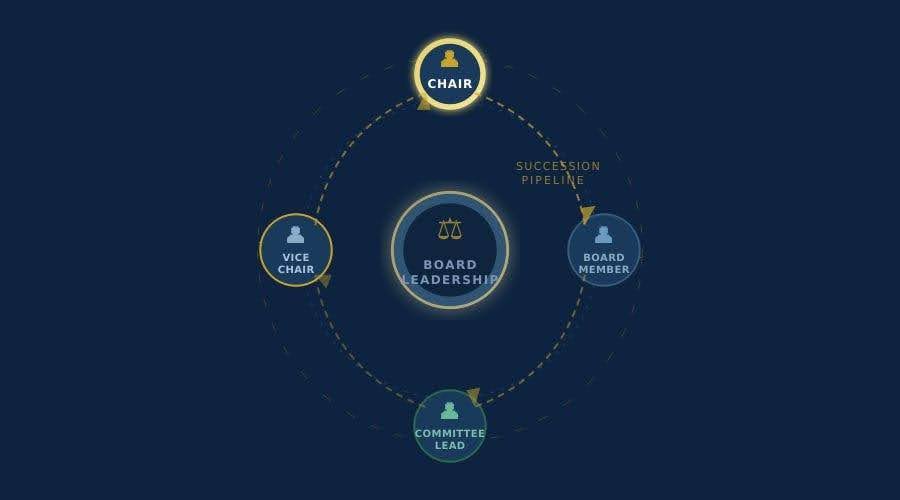
- Build the leadership pipeline before you need it. The best time to identify and develop your next board chair is while your current chair is still doing the job well. Committee chair roles are an excellent training ground — they offer real responsibility, visibility across the organization, and a chance to build relationships with staff leaders before stepping into a more senior governance role. Make leadership development a deliberate part of how you onboard, engage and develop board members.
- Make the vice-chair role meaningful. BoardSource recommends that organizations only elect vice-chairs who are genuinely prepared and willing to ascend to the chair position. Treat the vice-chair role as an apprenticeship — involve them in ED check-ins, committee work, and board meeting preparation. This is your most natural succession pathway; use it intentionally.
- Consider shared leadership. Some boards have found real success in dividing chair responsibilities between co-chairs, each serving staggered two-year terms. This approach distributes the workload, reduces burnout, and creates a built-in succession rhythm. Moreover, it ensures a level of consistency in how the board-staff partnership works while regularly infusing new energy and new ideas to move the organization forward. For boards where the demands of leadership are especially high, this model can make the role feel more sustainable — which means more people will actually be willing to take it on.
- Set and honor term limits. Term limits serve multiple purposes: they bring in fresh perspectives, guard against stagnation, and create natural succession moments that prompt the board to think proactively about where they are going and who’s coming next. Without them, boards can become comfortable — and complacent.
- Have an emergency plan. No one wants to think about the sudden loss of a key leader, but boards have a fiduciary duty to prepare for it. An emergency succession plan answers the essential questions in advance: Who steps in if the chair is suddenly unable to serve? What do we communicate to staff, donors, and stakeholders, and who delivers that message? Having these answers documented — and reviewed annually — means you won’t be scrambling for clarity in the middle of a crisis.
Succession as a Partnership — Not Just a Risk Management Tool
It’s worth stepping back to consider what succession planning is really about at its best.
When a board invests in developing future leaders, it’s doing more than managing organizational risk. It’s modeling the kind of engaged, forward-thinking governance that makes a real difference in the health of a nonprofit. It sends a message to staff that the board is serious about the long game, and expects the staff to do the same. It strengthens the board’s capacity to be a true partner to the Executive Director — providing the support, collaborative problem-solving, and consistency that any leader needs to thrive.
An ED who has seen multiple board chairs come and go with no preparation, no continuity, and no coherent handoff, learns over time, not to invest deeply in the board relationship. Worse yet, drastic changes in board leadership style and philosophy can cause otherwise successful leaders to reevaluate their own future and leave which often ripples through the staff. Succession planning — done well — is part of how you earn and sustain that trust. It says: *we take this governance work seriously, and we’re building something that outlasts any one of us.*
Starting the Conversation
If your board doesn’t have a succession plan, you’re not alone — but now is the time to change that. Here are a few questions to bring to your next board meeting or governance committee discussion:
-
- Do we have a vice-chair who is genuinely ready and willing to step into the chair role?
- Are we using committee leadership as a formal development pathway for future board officers?
- Do we have a written emergency plan for unexpected departures at both the board and staff leadership levels?
- When did we last have an honest conversation about the sustainability of our board chair role and whether the demands are reasonable?
- Are we onboarding new board members in a way that helps them envision a leadership path within the board?
The goal isn’t perfection. The goal is intentionality — the same quality that distinguishes truly effective boards in every other aspect of their governance work.
Strong boards don’t happen by accident. Neither does strong leadership continuity. Both require planning, cultivation, and a shared commitment to building something that lasts well beyond any individual’s tenure.